Overview of Two-Nation Theory and Independence
Those who argue that Hindus and Muslims are two irreconcilable nations simply based on the fact that India had to deal with Islamic invaders must also quantify how many of the sub-continent’s Muslims identified, or collaborated with such barbaric excesses of conquest. Did ordinary Muslims see Islamic invaders as their champions or liberators, as some [...]
Harappa
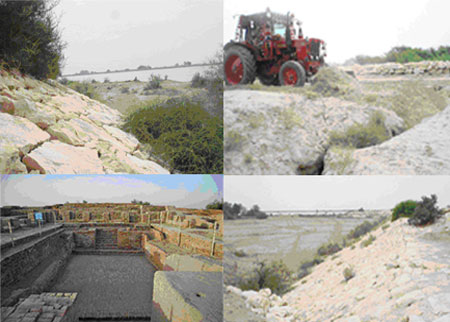
Harappa is an archaeological site in Punjab, northeast Pakistan, about 20 km (12 mi) west of Sahiwal. The site takes its name from a modern village located near the former course of the Ravi River, some 5 km (3 mi) southeast of the site.
The site contains the ruins of a Bronze Age fortified city, which [...]
Ancient Empires of the Sub-Continent
Some of the earliest relics of Stone Age man were found in the Soan valley near Rawalpindi, dating back to at least 50,000 years. Predominantly an agricultural region, its inhabitants learned to tame and husband animals and cultivate crops some 9,000 years ago. Farming villages dating from 6000 BC have been excavated in Baluchistan, the [...]
The Kingdom of Gandhara
The Hindu and Buddhist architectural heritage of Pakistan is part of a long history of settlement and civilization in Pakistan. The Indus Valley civilization collapsed in the middle of the second millennium BCE and was followed by the Vedic Civilisation, which extended over much of northern India and Pakistan.
The time period in the history of [...]
Arrival of Muhammad Bin Qasim
Muhammad bin Qasim first captured Daibul. He then turned towards Nirun, near modern Hyderabad, where he easily overwhelmed the inhabitants. Dahir decided to oppose the Arabs at Raor. After a fierce struggle, Dahir was overpowered and killed. Raor fell into the hands of the Muslims. The Arab [...]
How Pakistan Got it’s Name Chaudary Rehmat Ali
The name of the country Pakistan has a fascinating history – it is essentially an acronym!
Prior to 1947, the country now known as Pakistan was a British colony. In 1947 the United Kingdom granted independence to the region under a new name, Pakistan. The name had been developed by a group of students at Cambridge [...]
British rule in India
In the beginning of 17th century, Europeans, particularly British, started trading in the subcontinent. Merchants of the East India Company never imagined that British presence in the subcontinent could mean anything more than peaceful trading. French arrived in the middle of the 17th century, signaling the beginning [...]
Hindu and Buddhist architectural heritage of Pakistan
Photograph of the temple and gateway in Kashmiri style at Malot, Jhelum District, taken by Joseph David Beglar in the 1870s. Alexander Cunningham wrote in his report for the Archaeological Survey of India in 1872-3, “The only remains of any antiquity at Mallot are a temple and gateway in the Kashmirian style of architecture. They [...]
Establishment of Muslim EmpirePlaces Conquered
Though Muslims entered South Asia with the conquest of Sindh by Muhammad bin Qasim and then with the annexation of Punjab by Mahmud Ghaznavi, yet the real credit of the establishment of Muslim rule in the region goes to Shahab-ud-din Muhammad Ghuri. The Ghurids had a long history of differences with the Ghaznavids, which ultimately [...]
Pakistan Movement and the Challenge Today
While there are many reasons for Pakistanis to complain and express their despair, maybe one thing we could all celebrate about on this year’s Pakistan Day is the rise in Pakistan’s literacy rate. Yes, despite the tightening of educational resources in Pakistan, the extraordinary voluntary efforts of concerned Pakistanis, as well as the human development [...]