Historic Moenjodaro at risk again by floods
 As a result of the heavy monsoon rains and the recent floods in Pakistan, around 900,000 cusecs of water is expected to enter Sindh through the Indus River, during the first week of August.
According to sources, a wave of 400,000 cusecs has already passed through the Indus River, near Moenjodaro without causing significant damage to the ancient city.
The ravages of the Indus River, one of the largest rivers in the world, have been known from ancient times.
Dating back to the third millennium BC, the ancient city has been destroyed on more than one occasion by flooding of the Indus River. At least seven times it was rebuilt directly on top of the old ruins.
Moenjodaro was included on the United Nations Educational, Scientific and Cultural Organisation (UNESCO) World Heritage List in 1980. Spreading over an area of almost 600 acres, only 10 percent (50 acres) of its total area has been excavated so far.
It is regarded as the most ancient planned city in the world. The main building material is baked brick bedded with mud mortar, sometimes with added gypsum. With its monumental structural remains, street pattern, covered drains, baths, wells and all necessary features needed for sanitation and administration, the site is known as the first urban center of the Indus Valley civilization.
The Indus civilization is believed to have existed from 2350-1800 BC, but the exact knowledge is difficult as no records have survived. Only by chance in excavation in 1922, remains of the great civilization had been discovered.
While excavating a monastery with a Stupa dating back to the second century AD, coins of the Kushana king Vasudeva I, were found in a pot in one of the cells. Digging deeper, unknown artifacts, mainly square seals with unknown script, were found. In the same year, similar seals had been found at Harappa, 600 kilometres to the north, in Punjab. This brought to light the exciting remains of the Indus civilization. Major excavations between 1924 and 1931 showed the picture of a large urban compound.
Soon after the first excavations in 1923, the need for conservation became evident as the exposed structures began to deteriorate due to salt action in the bricks.
Due to the proximity of the Indus River, the high water table transports salt into the walls and water evaporates at the brick surface leaving behind the salt deposits which turn into crystals at lower temperatures during winters or early spring. These crystals increase its volume by 300 percent, damaging the historic fabric.
In 1974, after an appeal by the Pakistan government, UNESCO launched the International Safeguarding Campaign for Moenjodaro. It lasted until 1997 and mobilised around $8 million from its member states for large-scale conservation measures which aimed at protecting the site from flooding, implementation of national capacity building activities, and the installation of a conservation and monitoring laboratory.
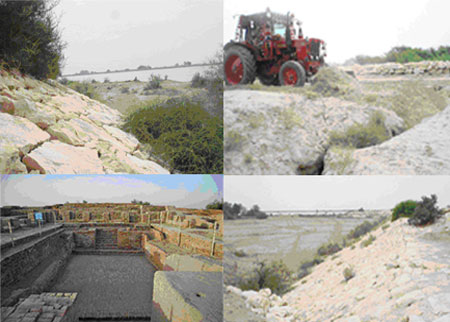
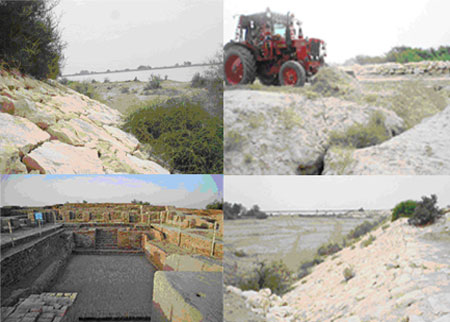
One of the most important achievements of the campaign was the river training of the Indus River by construction of five spurs along its banks to avert danger to the Moenjodaro archeological remains. UNESCO and the authority for preserving of Moenjodaro subcontracted the work to the Sindh Irrigation Department, that started in 1985 and continued till 1990.
According to the current project director of the National Fund for Moenjodaro (NFM) the average height of each spur is 20 feet.
The director informed that during the 1992 floods, 1,300,000 cusecs water passed through the Indus River, near Moenjodaro soaking the spurs to the height of four feet, without causing significant damage to the spurs and the site.
Around 900,000 cusecs of water is expected to pass near the site during the first week of August. The Sindh government has deployed the army and rangers and other manpower along with machinery to watch the water level on a 24-hour basis and take precautionary measures to cope with an emergency. The Sindh Irrigation Department’s staff was doing necessary maintenance work such as filling the ditches along the riverside.
Management of the site at Moenjodaro has also deployed a staff to make daily visits to the spurs on the riverside and monitor the water level. Since the present embankment was able to stand the heavy floods of 1992, it has been declared as strong enough to resist heavy floods, which was also supported by the scientific assessment conducted by the UNESCO in 1996, nonetheless, there are concerns that history may repeat itself.
This year’s floods, greater than any in living memory, may yet again destroy what remains of the ancient city of Moenjodaro.
Courtesy: Daily times