Ancient Empires of the Sub-Continent
 Some of the earliest relics of Stone Age man were found in the Soan valley near Rawalpindi, dating back to at least 50,000 years. Predominantly an agricultural region, its inhabitants learned to tame and husband animals and cultivate crops some 9,000 years ago. Farming villages dating from 6000 BC have been excavated in Baluchistan, the North West Frontier Province and Punjab.
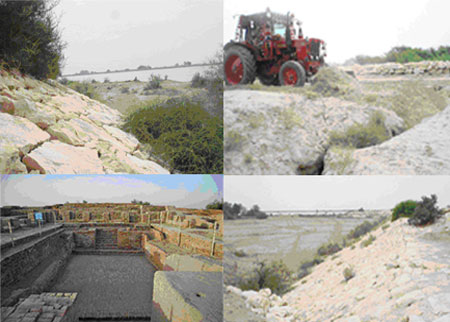
The Indus Valley Civilization is considered to have evolved around 2600 BC. Built on the ruins of fortified towns near Kot Diji, it is now believed to have emerged from farming communities of the area. The Civilization boasted immense cities like Moenjodaro and Harappa. These towns were well planned, with paved main roads, multistoried houses, watchtowers, food warehouses, and assembly halls. Their people developed an advanced script that still remains un-deciphered. The Indus Civilization’s decline around 1700 BC is attributed to foreign invaders, who at some sites violently destroyed the cities. But with recent research, historians have become unsure as to the exact causes of decline of the Indus Civilization.
Alexander the great Alexander the Great invaded the Sub-continent in 327 BC. Conquering the Kalash valley, he crossed the mighty Indus at Ohind, sixteen miles north of Attock. He then defeated the mighty elephant army of Porus at Jhelum, and began his march towards the long Ganges plain. However, he was forced to plan for homeward sailing when his war-wary troops refused to advance further. On his way back, a serious wound, received while battling the Malloi people at Multan, finally took its toll, and Alexander died in 323 BC, leaving his conquests for grab among his own officers.
Ashoka, son of Bindusara, was one of the greatest rulers the world hasAskoka the great ever known. Not only did he rule a vast empire; he also tried to rule it compassionately. After initially causing thousands of lives during his conquest of Kalinga, he decided to rule by the law of piety. He was instrumental in spreading Buddhism within and outside the Sub-continent by building Buddhist monasteries and stupas, and sending out missionaries to foreign lands.
The Greek king of Bactria, Demetrius, conquered the Kabul River Valley around 195 BC. The Greeks re-built Taxila and Pushkalavati as their twin capital cities in Gandhara. They were followed in 75 BC by the Scythians, Iranian nomads from Central Asia, and in about 50 BC by the powerful Parthians, from east of the Caspian Sea.