Pakistan’s army and its history of politics
The announcement by Pakistan’s army chief, General Pervez 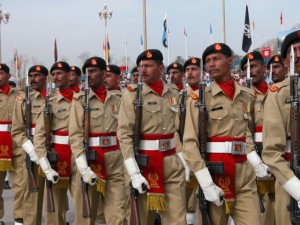 Musharraf, that the military had seized power came after several months of rumors of a possible military coup.
After mass opposition rallies and protests calling for Prime Minister Nawaz Sharif to step down, Washington had warned that it did not want to see any “extra constitutional” change in Pakistan.
The warning was symptomatic of fears for the stability of a country where the military has a long history of intervening at times of political upheaval.
Consulting the military:
Although Pakistan was founded as a democracy after the partition of the Indian sub-continent, the army has remained one of the country’s most powerful institutions.
This is in spite of the fact that in recent years it has stressed that it has no desire to become embroiled in politics.
Successive governments have made sure that the military was consulted before they took key decisions, especially when those decisions related to the Kashmir conflict.
Political leaders know that the army has stepped into the limelight before at times of crisis, and could do so again.
Turbulent history:
After Pakistan formally became a republic in 1956 under President Mirza, it faced an array of serious threats to its stability. Its conflict with India over Kashmir remained unresolved, relations with Afghanistan were poor, and the country suffered continuing economic difficulties, frequent cabinet crises, and widespread political corruption.
In October 1958, President Mirza abrogated the constitution and granted power to the army under General Muhammad Ayub Khan, who subsequently assumed presidential powers. The office of the prime minister was abolished and rule by decree introduced.
Ayub Khan’s autocratic rule lasted until 1969, when he was forced to resign following serious unrest.
He in turn was replaced by General Agha Muhammad Yahya Khan, the commander-in-chief of the army, who reimposed martial law. He stepped down following the civil war which resulted in independence for Bangladesh – fomerly East Pakistan – and military rule came to an end – temporarily.
Zulfikar Ali Bhutto became the new president, introducing a new constitution which came into effect in 1973. But after elections in 1977, Bhutto’s victory was challenged by the opposition, and widespread riots ensued.
Failure to reach a reconciliation prompted the army chief of staff, General Mohammed Zia ul-Haq, to depose Bhutto in a military coup and declare martial law. This remained in force until 1985.
Despite the subsequent return to civilian government, the politics of Pakistan have remained closely linked to the military.
Now the army’s actions appear to herald an end to what has been the longest period in Pakistan’s turbulent history in which the military has remained on the sidelines.
Latest Post
ArchitectureImportance Of Classical Architecture In Pakistan
Mosques In Pakistan: A True Embodiment Of Its Heritage
Modern Architecture Of Pakistan And Contemporary Designs
Articles
Seventh SWAT Rejuvenation
Heritage buildings on verge of destruction
Centuries Old Monuments at Taxila in Pakistan Damaged By Stone-Crushing Plants
Conservation
Historic Moenjodaro at risk again by floods
Renovation cost of Laal Shahbaz Qalander’s mausoleum increases
Germany provides Rs 9.3 mln for rehabilitation of historic houses in walled city of Lahore
Creative Art
Sadequain
Threads of experience – Tradational crafts from Pakistan to rochdale
Art in Pakistan
Culture
Conservation Of Pakistani Culture Over The Past Years
Culture of Pakistan
Religious Life of Pashtoons
History
History of Peshawar
Timeline of Pakistan’s historical events
Taxila
Travel Guides
Travel Guides – Looking Into Different Regions Of Pakistan
Sibi
Naran
Videos
Eid Mubarak-24 World Online