The Walled City of Lahore
 The Walled City of Lahore, also known as the “Old City,” or “Anderoon Shehr (اندرون شهر),” is the section of Lahore, Punjab, Pakistan, that was fortified by a city wall during the Mughal era.
Origins of Walled City of Lahore
The origins of the original Lahore are unspecific. According to carbon dating evidence of archaeological findings in the Lahore Fort, the time period may start as early as 2,000 B.C.E. Lahore had many names throughout its history. Mohallah Maulian represents one of the two most probable sites of the original Lahore. Sootar Mandi (the yarn market) inside Lohari Gate, had been called Mohallah Chaileywala Hammam located in Machli Hatta Gulzar, just off Chowk Chalka.
As late as 1864, the Lohari Mandi area had been known among the old folk of the Walled City as kacha kot, the mud fort, a name derived from the gradient of the land, the water flow, and the formation of mohallahs, kuchas, and kattrahs. The curve of Koocha Pir Bola merges with Waachowali Bazaar, the Lohari Bazaar merges with Chowk Lohari Mandi, and Chowk Mati merges with Papar Mandi, giving a sense of a mud fort. Along Lohari Bazaar, a short distance from Chowk Chakla, the street opens slightly, revealing a half-buried archway of pucca bricks and mud.
 The famous mud fort may have been built by Malik Ayaz, the first Muslim governor of Lahore. Lohari Gate served as the main entrance to Ayaz’s mud fort. Chowk Sootar Mandi constituted one important center of Kacha Kot. The lay of the streets also suggest the boundaries. At the time of Mughal Emperor Akbar, the original wall of the Walled City of Lahore stood, on the western side, to the right of Bazaar Hakeeman in Bhati Gate. On the eastern side to the left of Shahalam Gate, curved eastwards and formed a “kidney-shaped” city that depended on the flow of the curving River Ravi. Thus the Lahore of the kacha kot era has continued to expand in three major leaps of expansion, each with an almost 400-year gap. The eras of Raja Jaipal of Akbar and of Maharaja Ranjit Singh mark the high points of that expansion.
The expanding of the mud fort had its origins in three factors:
- the way the Ravi has flown and how and when it has been changing its course,
- the existence of the Lahore Fort and how power has flowed from the rulers, and
- the manner the population and economy of the old original Walled City has changed over time, grown, or even shrunk, depending of invasions, droughts and famines in the countryside.
The story of kacha kot has been determined by those factors. The oldest buildings in the entire Walled City exist in this area, among them the old exquisite mosque known even now as Masjid Kohana Hammam Chaileywala. A huge hammam may have stood during the kacha kot period. The tomb of Pir Bola (Gali) still exists. Little remains of the original mud fort.
Demographics
The Walled City of Lahore covers an area of 256 ha with a population of 200,000. The city walls were destroyed shortly after the British annexed the Punjab in 1849 and were replaced with gardens, some of which exist today. The Circular Road links the old city to the urban network. Access to the Walled City is still gained through the 13 ancient gates, or their emplacements.
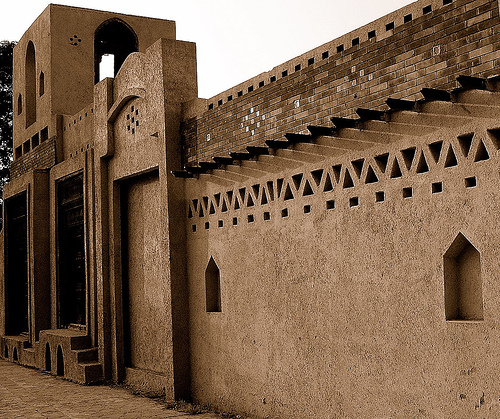
The convoluted and picturesque streets of the inner city remain almost intact, but the rapid demolition and frequently illegal rebuilding taking place throughout the city is causing the historic fabric to be eroded and replaced by inferior constructions. Historic buildings are no exception, and some have been encroached upon. The few old houses in the city are usually two or three stories tall, with brick façades, flat roofs, richly carved wooden balconies and overhanging windows.